Earlier this week, we entered The Ransomware Crypt, where critical systems are locked, sensitive data may be stolen, and business operations can grind to a halt.
We explored an uncomfortable reality:
Ransomware isn't just an IT problem. It's a business interruption event.
And while backups are important, simply having copies of your files doesn't guarantee you'll be able to resume operations quickly.
So how do you escape the crypt?
The answer isn't one product, one security tool, or one backup system.
It's a combination of prevention, detection, response, and recovery.
Welcome back to Week 6 of Zog's 8 Weeks of Cyber Horrors.
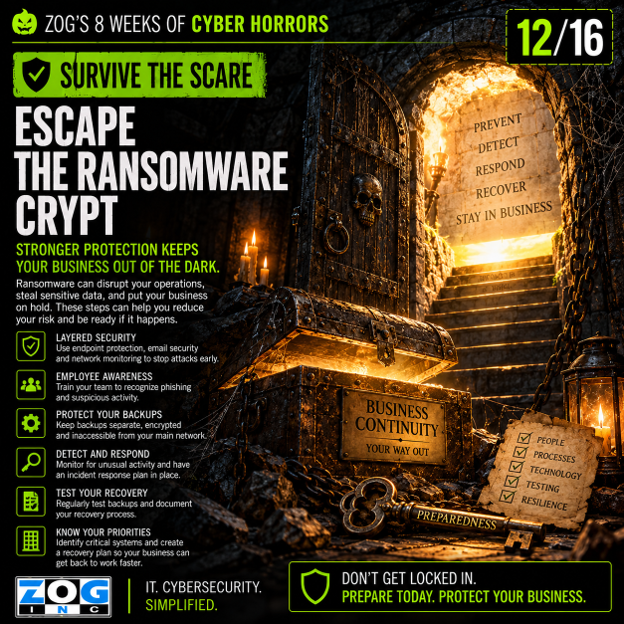
It's time to SURVIVE THE SCARE.
Build Layers of Protection
The best ransomware recovery is avoiding an attack in the first place.
No single security tool can stop every threat, which is why businesses need multiple layers of protection.
That includes:
- Endpoint protection: Detect and block malicious activity on computers and servers.
- Email security: Reduce phishing attempts and malicious attachments.
- Multi-factor authentication (MFA): Make stolen passwords less useful to attackers.
- Patch management: Address known vulnerabilities before criminals exploit them.
- Network monitoring: Identify suspicious activity before it spreads.
These protections work together.
If one layer fails, another may prevent an attacker from gaining access or moving further into your environment.
The goal is to make it harder for ransomware to get in—and harder for it to spread.
Train Employees to Recognize the Warning Signs
Technology matters, but employees remain an important part of your defenses.
Ransomware attacks can begin with something as ordinary as a convincing email.
A fake invoice.
A malicious attachment.
A link to a fraudulent login page.
Employees should know how to recognize suspicious requests and, just as importantly, how to report them.
The objective isn't to make everyone a cybersecurity expert.
It's to create a culture where employees feel comfortable saying:
"Something doesn't look right. I'm going to check."
Early reporting can make a significant difference.
Detect Problems Before They Become Disasters
Ransomware doesn't always announce itself immediately.
Attackers may spend time exploring systems, stealing information, or attempting to disable security protections before deploying ransomware.
That's why monitoring matters.
Businesses should have tools and processes to identify unusual activity, investigate alerts, and respond quickly.
Suspicious logins, unexpected administrative activity, unusual file access, or attempts to disable security tools may provide important warning signs.
The sooner suspicious activity is detected, the better the opportunity to contain it.
Protect Your Backups From the Attack
Earlier in our campaign, The Backup Vault highlighted the importance of reliable backups and tested recovery.
That lesson becomes especially important here.
Ransomware attackers sometimes deliberately target backup systems because they know backups can help businesses recover without paying.
Backups should be protected from the same compromise affecting production systems.
That may include isolated or immutable backup copies, restricted administrative access, and secure backup credentials.
And don't assume that a successful backup notification means everything is ready.
A backup is only valuable if you can actually restore it.
Have an Incident Response Plan
When ransomware strikes, confusion can make an already difficult situation worse.
Who determines which systems should be disconnected?
Who contacts your cybersecurity provider?
Who communicates with employees and customers?
Who involves legal counsel, insurance representatives, or other outside experts?
These responsibilities should be established before an incident occurs.
Your incident response plan should outline how to contain the threat, investigate what happened, communicate appropriately, and begin recovery.
It should also be accessible if your normal systems are unavailable.
The middle of an attack is the wrong time to decide who's in charge.
Know What Must Come Back First
Not every system is equally important to keeping your business operational.
Your accounting platform, production systems, customer records, or communication tools may be essential.
Other applications might be able to wait.
Identify your most critical systems and establish recovery priorities.
Then determine how much downtime your business can tolerate and how much data loss is acceptable.
This helps your IT team develop a recovery strategy based on business needs rather than simply restoring systems in whatever order is easiest.
Test the Entire Recovery Process
Having a plan is important. Knowing it works is better.
Regularly test your ability to restore systems and resume operations.
That means looking beyond whether files can be recovered.
Can employees access the applications they need?
Are systems functioning correctly?
Can customers be served?
Are there dependencies that could delay recovery?
Testing helps uncover weaknesses before an actual emergency.
The goal isn't just to restore your data. It's to restore your business.
A Business Leader's Question
This week, ask your leadership and IT teams:
"If ransomware hit us tomorrow, do we have a tested plan to contain the attack, restore our critical systems, and keep our business operating?"
You should hear about layered security, monitoring, protected backups, incident response responsibilities, recovery priorities, and testing.
Not simply:
"We have backups."
Survive the Scare
Ransomware may be one of the most disruptive cyber threats businesses face, but preparation can reduce both the likelihood and impact of an attack.
Build layers of protection. Train employees. Detect threats early. Protect your backups. Establish response procedures. Know your recovery priorities. Test your plan.
Because when ransomware locks the door, your best way out is a recovery plan you prepared before the attack.
Don't get locked in. Prepare today. Protect your business.



Leave a Comment
Your email address will not be published. Required fields are marked *