The ransomware attack is over, your systems are back online, and your customers are being served.
You think the nightmare is finally behind you.
Then the questions begin.
Was sensitive customer information exposed?
Did you meet your regulatory obligations?
Will your cyber insurance cover the incident?
Can you prove the security controls you were required to maintain were actually in place?
Suddenly, recovering your systems was only the beginning.
Welcome to Week 7 of Zog's 8 Weeks of Cyber Horrors.
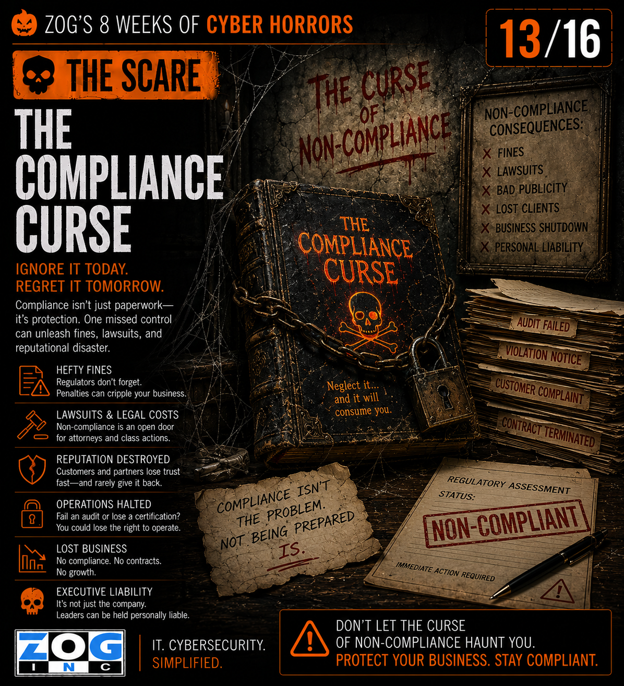
This week, we're entering The Compliance Curse, where cybersecurity failures can create legal, financial, regulatory, and contractual consequences that linger long after an incident.
The Attack May End. The Obligations Don't.
Most business leaders understand that a cyberattack can cause downtime, lost productivity, and unexpected expenses.
But what happens after the immediate crisis?
Depending on your industry, the information involved, and the regulations or contracts that apply, your organization may have additional responsibilities.
You may need to investigate what happened, determine whether sensitive information was exposed, notify affected parties, or provide information to regulators and business partners.
And those responsibilities don't necessarily disappear when your IT systems are restored.
Getting back online doesn't automatically mean you're back in compliance.
Compliance Isn't Just for Large Companies
There's a common misconception that cybersecurity compliance is primarily a concern for large corporations.
But small and midsize businesses can face significant obligations too.
Consider a few examples:
Healthcare organizations may have obligations under HIPAA to protect patient information.
Government contractors may face cybersecurity requirements under contracts and frameworks such as CMMC.
Financial institutions and certain other businesses may be subject to requirements involving customer information, security safeguards, and incident reporting.
Businesses that accept payment cards may have obligations under PCI DSS.
And organizations across industries may be affected by state privacy and breach-notification laws.
The specific requirements vary, but the underlying lesson is the same:
Your organization's compliance obligations depend on what you do, what information you handle, and whom you do business with.
The Insurance Question Nobody Wants to Hear
Cyber insurance can be an important part of managing financial risk.
But having a policy doesn't mean every cyber-related expense will automatically be covered.
Coverage depends on the policy's terms, conditions, exclusions, and the circumstances of the incident.
Businesses may be asked about security practices when applying for or renewing coverage.
Those questions can involve multi-factor authentication, backup procedures, endpoint protection, employee training, or other controls.
Now imagine experiencing a cyberattack and discovering that your actual security practices don't match what was represented during the application process.
That discrepancy could create serious complications.
Cyber insurance is a financial safety net, not a substitute for cybersecurity.
The Hidden Danger of Assuming You're Compliant
Here's where the curse can become especially dangerous.
Your company completed a security assessment two years ago.
A policy document exists somewhere.
Your IT provider installed security tools.
Someone checked the boxes on a questionnaire.
So leadership assumes everything is covered.
But cybersecurity requirements and business environments change.
Employees come and go.
New applications are introduced.
Vendors gain access.
Systems are upgraded.
Regulations and contractual requirements evolve.
A security control that existed during your last assessment may no longer be functioning as intended.
And a written policy doesn't prove that the organization consistently follows it.
Compliance isn't something you achieve once and forget about.
Documentation Matters
Imagine being asked to demonstrate that your organization followed its required security procedures.
Could you produce evidence?
Could you show when employees received cybersecurity training?
Could you demonstrate that access permissions were reviewed?
Could you provide records of vulnerability remediation, security monitoring, or incident response testing?
Could you show that your policies were reviewed and maintained?
Having security controls is important.
Being able to demonstrate that those controls were operating is important too.
When regulators, insurers, auditors, or customers ask questions, "We thought we were protected" may not be a sufficient answer.
A Business Leader's Question
This week, ask your leadership and IT teams:
"If we experienced a cybersecurity incident tomorrow, could we demonstrate that we were meeting the security requirements that apply to our business?"
Then consider:
- Do we know which regulations and contractual requirements apply?
- Are our security policies current?
- Are required controls actually implemented?
- Do we regularly review and document compliance?
- Are we confident our insurance representations match reality?
These questions aren't meant to create unnecessary paperwork.
They're meant to identify business risks before those risks become expensive surprises.
Welcome to the Compliance Curse
A cyberattack can be devastating on its own.
But the consequences may extend far beyond downtime and recovery costs.
Regulatory investigations. Contractual disputes. Insurance complications. Legal expenses. Reputational damage.
And sometimes, the most difficult question isn't what happened during the attack.
It's what your organization should have been doing before it happened.
Can You Survive the Scare?
On Thursday, we'll show you how to Break the Compliance Curse by identifying applicable requirements, implementing security controls, maintaining documentation, and making compliance an ongoing business process.
Because the worst time to discover a compliance gap is after someone asks you to prove it was never there.



Leave a Comment
Your email address will not be published. Required fields are marked *