Earlier this week, we entered The Compliance Curse, where a cyberattack can create consequences that last long after systems are restored.
Regulatory investigations. Insurance complications. Contractual disputes. Questions about whether required security controls were actually in place.
And one particularly uncomfortable question:
"Can you prove your business was doing what it was supposed to do?"
The good news?
You don't have to wait for an audit, insurance claim, or cybersecurity incident to find out.
Breaking the Compliance Curse starts with understanding your obligations, implementing the right controls, and maintaining evidence that those controls are working.
Welcome back to Week 7 of Zog's 8 Weeks of Cyber Horrors.
It's time to SURVIVE THE SCARE.
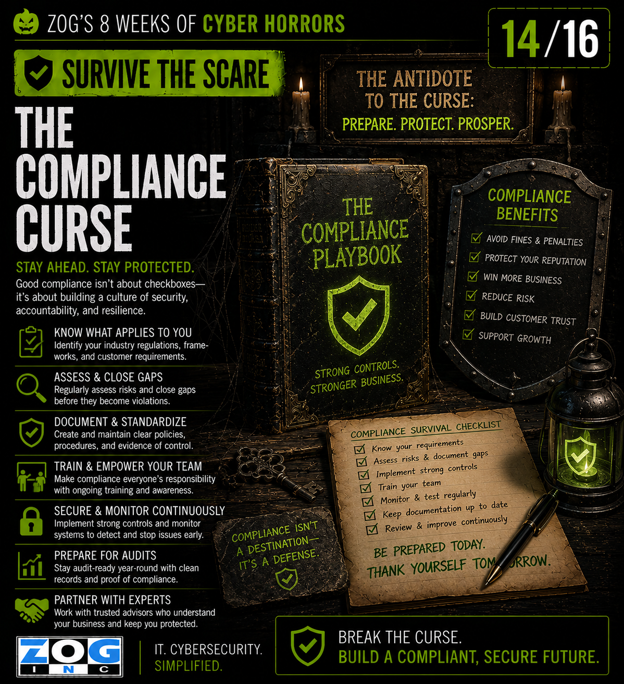
Know Which Requirements Apply to Your Business
You can't meet requirements you haven't identified.
Depending on your industry, customers, contracts, and the information you handle, your organization may be subject to different cybersecurity obligations.
Healthcare organizations may face HIPAA requirements.
Government contractors may have obligations related to CMMC or other federal cybersecurity standards.
Businesses handling payment card information may need to comply with PCI DSS.
Others may face state privacy laws, contractual security requirements, or cybersecurity insurance conditions.
Start by identifying which requirements actually apply to your organization.
Don't assume that because you're a small business, compliance doesn't apply to you.
Assess Where You Stand Today
Once you understand your obligations, determine whether your current security practices meet them.
That means looking beyond whether you have antivirus software, firewalls, or backups.
A meaningful assessment should examine your policies, procedures, technical controls, access management, employee training, and incident response capabilities.
Are security controls configured correctly?
Are employees following documented procedures?
Are vulnerabilities being identified and addressed?
Are there gaps between what your policies say and what your organization actually does?
You can't fix a compliance gap you don't know exists.
Build Security Controls Around the Requirements
Compliance shouldn't simply mean producing documents for an auditor.
It should mean putting protections in place that reduce actual business risk.
Depending on your requirements, those protections may include:
- Multi-factor authentication
- Endpoint security and monitoring
- Vulnerability management and patching
- Access controls and regular permission reviews
- Secure backup and recovery procedures
- Employee cybersecurity awareness training
- Incident response planning
The goal is to connect each requirement to a real security practice.
A policy that says employees must use MFA isn't particularly useful if MFA isn't actually enforced.
A documented control and an operating control aren't always the same thing.
Document What You're Doing
Here's where many organizations struggle.
They may have good security practices but lack the documentation needed to demonstrate them.
Imagine being asked to provide evidence that your organization regularly reviews access permissions.
Could you produce it?
What about records of employee training, vulnerability remediation, backup testing, or security assessments?
Documentation shouldn't be an afterthought.
Establish a consistent process for recording security activities, maintaining policies, tracking corrective actions, and retaining appropriate evidence.
Because when someone asks whether a control was operating six months ago, "We're pretty sure it was" isn't the answer you want to give.
Make Compliance an Ongoing Process
One of the biggest mistakes businesses make is treating compliance like an annual event.
Complete the assessment.
Fix a few issues.
Pass the audit.
Move on.
But businesses change constantly.
Employees leave. Vendors gain access. New applications are introduced. Security threats evolve. Regulations and contractual requirements change.
A control that worked last year may not be effective today.
That's why compliance needs ongoing attention.
Schedule regular reviews, monitor important controls, track remediation activities, and revisit policies when business or regulatory requirements change.
Being audit ready means maintaining readiness—not scrambling when an audit is announced.
Make Leadership Part of the Process
Cybersecurity compliance can't live entirely within the IT department.
Leadership needs to understand which requirements apply, what risks exist, and where the organization may be exposed.
That doesn't mean executives need to become compliance experts.
It means they should receive clear information about:
- Current compliance status
- Significant security gaps
- Remediation priorities
- Business risks associated with unresolved issues
- Progress toward meeting requirements
Someone also needs to be accountable for making sure identified problems are addressed.
When compliance becomes part of regular business discussions, it's less likely to become a last-minute emergency.
A Business Leader's Question
This week, ask your leadership and IT teams:
"If an auditor, customer, insurer, or regulator asked us tomorrow to demonstrate our cybersecurity compliance, what evidence could we provide?"
Could you show current policies?
Documented security controls?
Training records?
Access reviews?
Evidence of vulnerability management and incident response preparation?
If the answer involves searching through old files and hoping everything is there, your organization may have work to do.
Survive the Scare
Breaking The Compliance Curse doesn't mean eliminating every cybersecurity risk.
It means understanding your obligations, implementing appropriate controls, documenting what you're doing, and continually evaluating whether those controls remain effective.
Start with an assessment. Address the gaps. Maintain the evidence. Review your progress. Keep leadership involved.
Because compliance isn't simply about passing an audit.
It's about protecting your business—and being able to prove you're doing it.
Don't wait until someone asks for the evidence.
Be Audit Ready.



Leave a Comment
Your email address will not be published. Required fields are marked *