Earlier this week, we unleashed The AI Monster.
We explored how artificial intelligence can make cyberattacks more convincing, how AI agents can be manipulated into taking unintended actions, and why giving AI systems too much access can create serious business risks.
But here's the good news.
You don't have to stop using AI to protect your business.
In fact, organizations that approach AI strategically can benefit from greater efficiency, improved productivity, and new opportunities for growth.
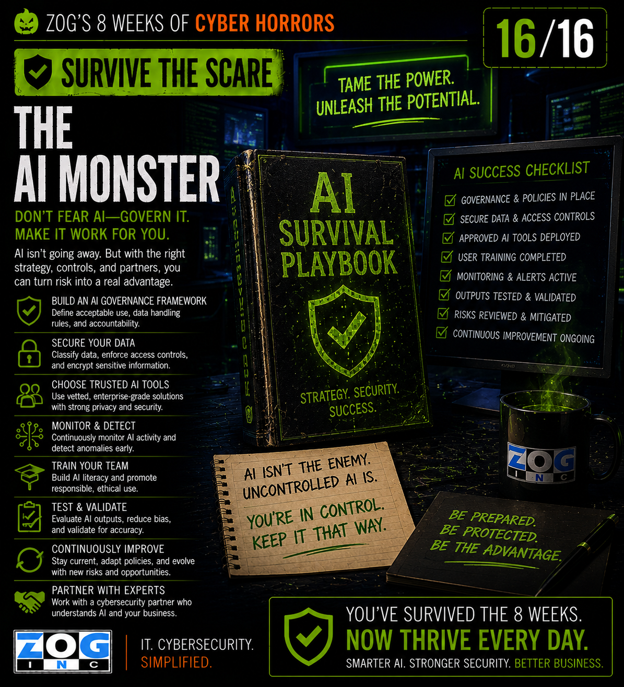
The key is making sure AI operates within clearly defined boundaries.
Welcome to the final SURVIVE THE SCARE of Zog's 8 Weeks of Cyber Horrors.
It's time to tame the monster.
Know Where AI Is Already Being Used
Before you can secure AI, you need to know where it's operating.
And that may be more complicated than you think.
Employees are experimenting with AI tools to draft emails, summarize meetings, analyze spreadsheets, and automate everyday tasks.
Some applications already include AI capabilities that employees may not even recognize as artificial intelligence.
Start by identifying which AI tools are being used across your organization.
Which ones are approved?
What business information are employees sharing with them?
Are AI agents connected to company applications or databases?
You can't manage AI risks you don't know exist.
Give AI Only the Access It Needs
One of the most important cybersecurity principles is least privilege.
Simply put, users and systems should only have access to the information and capabilities necessary to perform their jobs.
The same principle applies to AI.
An AI assistant that summarizes customer service requests shouldn't automatically have permission to modify financial records.
An AI agent that reviews invoices shouldn't be able to change vendor banking information without appropriate authorization.
And an AI tool that analyzes internal documents shouldn't have unrestricted access to every file in your organization.
Review the permissions granted to AI tools and agents.
Limit access to sensitive data and restrict the actions they can perform.
Just because AI can do something doesn't mean it should be allowed to.
Keep Humans Involved in Important Decisions
AI agents can perform increasingly complex tasks with limited human involvement.
That can save time, but it also introduces risk.
Consider an agent that can initiate payments, modify customer information, delete records, or send confidential documents.
Those actions can have significant consequences if the system makes a mistake or is manipulated.
Establish approval requirements for high-risk activities.
Financial transactions, changes to sensitive information, and other consequential actions should have appropriate human oversight.
Automation should increase efficiency, not eliminate accountability.
Protect Sensitive Business Information
Employees may not realize that entering confidential information into an AI tool can create data privacy and security concerns.
Customer records, employee information, financial documents, intellectual property, and confidential business plans all deserve appropriate protection.
Organizations should establish clear rules about what information can be shared with AI systems.
They should also evaluate how AI providers handle data, including retention, access, and whether submitted information may be used for model improvement.
Where possible, use approved business tools with appropriate security and administrative controls.
Your company's sensitive information shouldn't become the price of convenience.
Watch for Manipulated Instructions
Remember the prompt injection attacks we discussed earlier this week?
These attacks attempt to manipulate AI systems through malicious instructions embedded in emails, documents, websites, or other content.
Businesses using AI agents should treat external content as untrusted.
Technical safeguards should separate an agent's authorized instructions from information it retrieves or processes.
Sensitive actions should require additional checks, and AI systems should not be allowed to execute arbitrary instructions simply because they appear in a document.
No single defense eliminates every prompt injection risk.
That's why restricted permissions, monitoring, and human approvals are so important.
Establish an AI Acceptable Use Policy
Employees need guidance about how AI should and shouldn't be used.
A practical AI policy should address:
- Which AI tools are approved for business use
- What information employees may share
- When human review or approval is required
- Which activities are prohibited
- How employees should report AI-related security concerns
The policy doesn't need to discourage innovation.
It should help employees use AI confidently and responsibly.
And like other cybersecurity policies, it should be reviewed as technology and business needs evolve.
Monitor, Review, and Adjust
AI governance isn't a one-time project.
As AI tools gain new capabilities and businesses introduce additional integrations, risks can change.
Regularly review AI access permissions, connected applications, security settings, and activity logs where available.
Test important workflows before expanding automation.
Make sure someone is responsible for evaluating new AI tools and reviewing how existing systems are used.
Responsible AI adoption requires ongoing oversight.
A Business Leader's Question
As we conclude our eight-week journey, here's one final question to bring to your leadership and IT teams:
"Are we adopting AI in a way that helps our business grow while maintaining control over our data, systems, and decisions?"
If you can't confidently answer that question, now is the time to evaluate your AI readiness.
The Final Survive the Scare
Over the past eight weeks, we've explored backup failures, botnets, phishing, password security, impersonation, ransomware, compliance gaps, and AI risks.
Different threats. Different consequences.
But one common lesson:
Cybersecurity isn't just about technology. It's about protecting your ability to operate, serve customers, and grow your business.
AI is no exception.
With appropriate security, clear policies, limited permissions, and human oversight, businesses can take advantage of AI's potential while managing the risks.
The goal isn't to fear the monster.
It's to keep it under control.
Accelerate With AI. Protect With Cyber.



Leave a Comment
Your email address will not be published. Required fields are marked *